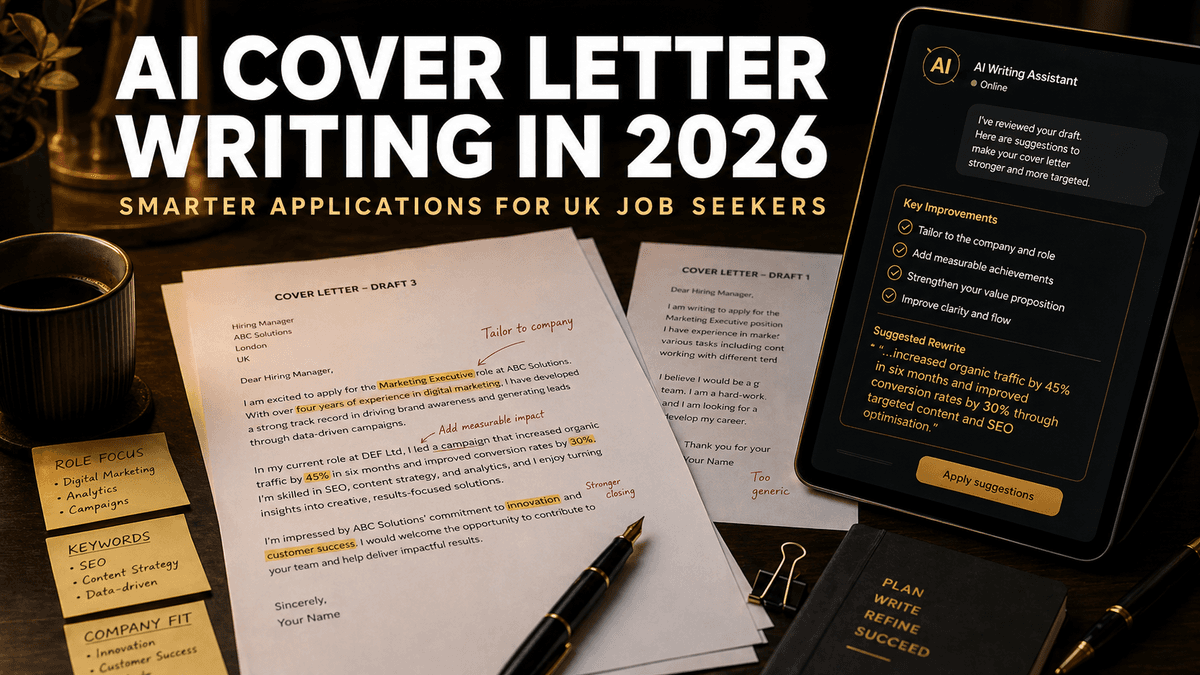
A good cover letter still matters in 2026, but not for the reason most job seekers think. It is no longer just a polite introduction. It is a positioning document that explains why you fit this role, this employer, and this moment in your career. AI can help you write that much faster, provided you use it to sharpen your thinking rather than replace it.
Start With the Job Description First
Before writing a cover letter, check how closely your CV matches the role. That gives AI the right context and stops the letter drifting into generic claims.
Check My CV Match →What AI Is Actually Good at in Cover Letter Writing
AI is most useful when the core problem is speed and structure. It helps you:
- Pull out the key themes from a job description
- Suggest stronger opening lines than "I am writing to apply..."
- Turn vague experience into tighter, more outcome-focused examples
- Mirror employer language without sounding robotic
- Create tailored first drafts in minutes instead of starting from a blank page
What it does not do well by default is understand which parts of your experience are most credible, most differentiated, and most commercially relevant. That part still needs your judgement.
What UK Recruiters Actually Do With Cover Letters
The data on cover letter reading in the UK is more nuanced than most job seekers assume. According to a 2024 survey of 625 UK and Ireland hiring managers by CV Genius:
- 57% of UK hiring managers say cover letters are influential or extremely influential in their hiring decisions
- 61% say a cover letter helps them understand a candidate's soft skills that the CV cannot convey
- 49% would consider interviewing an underqualified candidate if they submitted a highly persuasive cover letter
- 30% rarely read them at all — mainly in high-volume roles where CVs are screened by ATS first
The practical conclusion: in roles where a human reads applications, a strong cover letter moves you forward. In high-volume ATS-filtered roles, it reinforces keyword alignment. Either way, it is not optional.
The strongest cover letters answer three questions quickly:
- Why this role?
- Why you?
- Why this employer?
If you are targeting a marketing role, our Marketing Manager CV template is a good example of how to align the CV and cover letter around the same role language.
If your letter does not answer those clearly, it reads like a template. AI should help you get to those answers faster, not bury them under generic enthusiasm.
A Better AI Workflow for Cover Letters
Step 1: Analyse the job description
Before generating anything, identify the 3-5 signals the employer cares about most. These usually include:
- The core skills they repeat
- The level of ownership they expect
- The industry context or commercial environment
- The soft skills they care about, such as stakeholder management or communication
If your CV is not aligned to those signals yet, fix that first with the ATS Resume Checker.
Step 2: Feed AI better inputs
AI cover letters are only as good as the context you provide. Give it:
- Your current CV or key experience points
- The full job description
- The company name and what they do
- Any specific achievements you want highlighted
A weak prompt produces a weak letter. A strong prompt usually names the role, the employer, the tone, and the two or three achievements that should anchor the letter.
Step 3: Improve one paragraph at a time
Most people ask AI to generate the whole letter in one go. That is usually where quality drops. A better approach is:
- Generate the opening paragraph separately
- Generate one evidence paragraph based on a relevant achievement
- Generate a closing paragraph that shows intent and fit
This gives you more control and makes the final letter feel closer to your real voice.
The Structure That Works Best
Opening paragraph
State the role, the reason it is relevant to you, and one clear positioning line. Example logic:
"I am applying for the Senior Operations Manager role because it combines two areas where I have delivered measurable results: cross-functional delivery and process improvement in fast-growing service businesses."
Middle paragraph
This is the value paragraph. It should contain one strong example, not three weak ones. AI is useful here for tightening the wording and bringing the result to the front:
- What was the challenge?
- What did you do?
- What changed because of it?
Closing paragraph
Show fit without sounding desperate. The goal is not "I would love the opportunity." The goal is a credible final paragraph that links your background to the employer's context and invites further discussion.
The AI Cover Letter Risk UK Recruiters Are Watching For
The same CV Genius 2024 survey of UK hiring managers found that 80% view AI-generated CV and cover letter content negatively, 57% would be less likely to hire or would reject outright, and 74% claim they can detect AI-written applications. This does not mean you cannot use AI — it means you cannot use it lazily.
The tells recruiters spot most often:
- Generic openings that could apply to any role at any company
- Repetition of the CV word for word, without adding interpretation or context
- Invented details or inflated claims that fall apart under interview questioning
- American phrasing ("I am excited to leverage my skill set") that reads as a US template in a UK application
- Excessive length that buries the strongest evidence under filler paragraphs
AI often over-writes. In most cases, shorter and sharper wins. Edit the output down, not up.
How AI and ATS Work Together
Cover letters are not scored as heavily as CVs in most workflows, but they still reinforce relevance. If your CV and cover letter use the same role language, they create a more consistent application package. That matters when recruiters skim quickly or when AI systems extract themes from both documents.
This is why the best sequence is:
- Tailor your CV to the role
- Check your ATS match score
- Use that context to build the cover letter
Best Prompt Pattern to Use
Write a concise UK cover letter for a Product Marketing Manager role at a B2B SaaS company. Use a professional but direct tone. Emphasise my experience in campaign strategy, cross-functional launches, and pipeline growth. Keep it under 300 words and align closely with the job description.
Then refine from there. Ask AI to make the opening stronger, cut repetition, or increase specificity in the evidence paragraph.
How JobSpace AI Helps
If you already know your CV needs work, start there. Our ATS Resume Checker shows which keywords and role signals are missing. Then use the AI Cover Letter Generator to build a tailored draft that follows the same role language. If your CV needs rewriting first, use the AI CV Builder before generating the letter.
Frequently Asked Questions
Can AI write a good cover letter by itself? ▼
Should my cover letter repeat my CV? ▼
How long should an AI-generated cover letter be? ▼
What should I do before generating a cover letter? ▼
Next Step
Turn this advice into a stronger application
Start with the ATS checker to find keyword gaps, then use the AI CV builder to rewrite your CV for the role you want.
Related Articles
Keep building the cluster
AI Job Application Tools
How to Use AI to Tailor Your CV for Specific Job Applications (UK 2026)
Learn how to use AI to tailor your CV for every job application. Step-by-step guide for UK job seekers — improve your ATS score and get more interviews in 2026.
Read articleAI Job Application Tools
AI-Powered Interview Preparation: How to Practice Smarter (UK 2026)
Use AI to prepare for interviews in 2026. Learn how to practise answers, identify weak spots, and connect interview prep back to your CV and job description.
Read articleAI Job Application Tools
Beat the Bots: 2025 UK Guide to AI-Driven Hiring
Learn why 70% of UK employers use AI screening. Build ATS-friendly CVs, cover letter strategies + interview plans to beat bots in 2025!
Read article