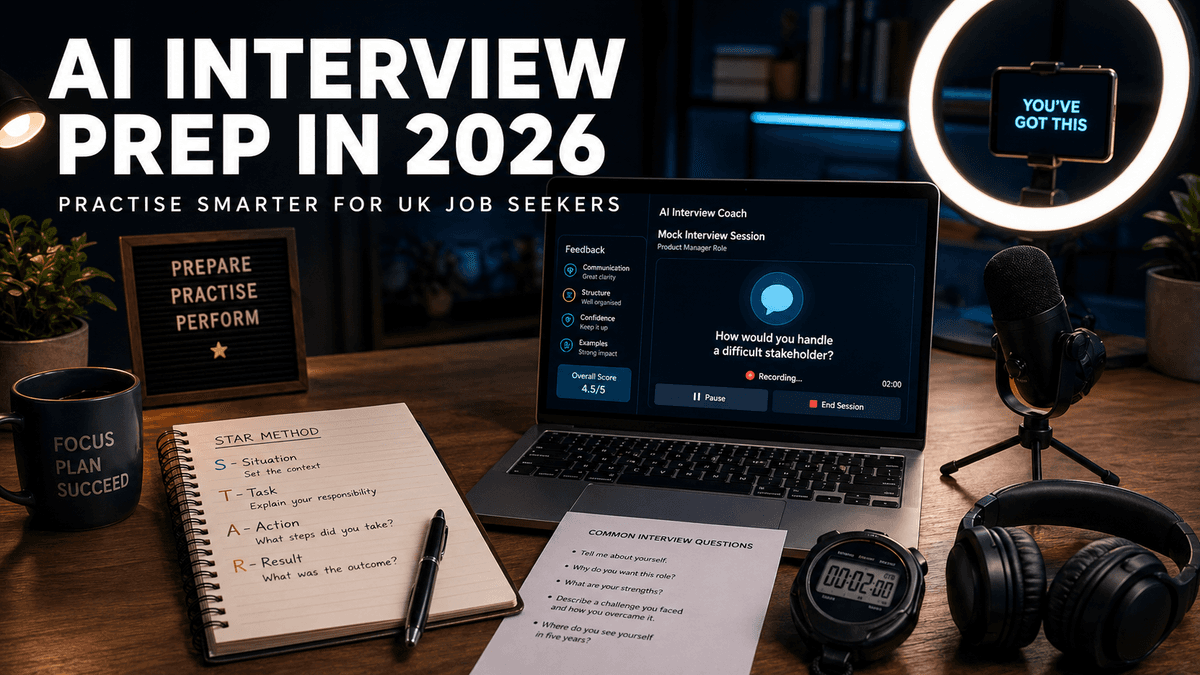
Interview preparation in 2026 is no longer just about memorising common questions. The best candidates prepare against the actual role, the likely evaluation criteria, and the story their CV already tells. AI helps because it gives you a fast way to simulate that process, spot weak answers, and practise with better structure.
Get the CV Right Before the Interview
Interview answers are stronger when they are built on a CV that already matches the role. Start with your CV, then use AI to practise the story behind it.
Check My CV First →Why AI Interview Prep Works
Most people prepare inefficiently. They read generic lists of questions, rehearse vague answers, and only discover their weak spots in the interview itself. AI improves that by helping you:
- Generate likely questions from a real job description
- Pressure-test your answers for clarity and relevance
- Turn broad experience into stronger STAR examples
- Spot missing evidence, weak structure, or poor role alignment
- Practise repeatedly without waiting for another person to help
The Best Inputs for AI Interview Practice
AI becomes much more useful when it has the right context. Give it:
- The target job description
- Your CV or a summary of your recent experience
- The type of interview: behavioural, competency, technical, or values-based
- The level of the role: junior, mid, senior, or leadership
If you are preparing for delivery-heavy roles, our Project Manager CV template helps you tighten the CV examples that usually become your best interview stories.
That changes the output from generic interview prep into role-specific rehearsal.
How to Use AI for Behavioural Questions
Start with the likely themes
Most behavioural interviews are testing a small set of patterns, such as:
- Ownership
- Problem solving
- Stakeholder management
- Communication
- Adaptability
Ask AI to identify which of those are most likely for the role you are targeting. Then practise one example for each.
Use STAR, but make it specific
AI is particularly useful for strengthening STAR answers. It can help you tighten:
- The situation so it is short and relevant
- The task so your responsibility is clear
- The action so the detail sounds credible
- The result so it ends with impact, not just activity
Weak answers usually fail because they spend too long on context and not enough on what changed because of your work.
How to Use AI for Technical or Role-Specific Questions
Technical interview prep should not just test knowledge. It should test explanation. AI can help you practise how you talk through:
- Why you chose one approach over another
- How you prioritised under pressure
- How you measured outcomes
- What you would improve if you did the work again
Those are often the difference between a technically correct answer and a convincing one.
The Practical AI Interview Workflow
Step 1: Tailor your CV
Use the ATS Resume Checker to identify the missing signals for the role. If needed, update the CV in the AI CV Builder first.
Step 2: Generate likely questions
Ask AI to create 10 likely interview questions based on the role, split across behavioural, technical, and motivation questions.
Step 3: Answer out loud
Typing answers is helpful, but speaking them is better. You will hear where the answer drags, where it lacks evidence, or where the point is unclear.
Step 4: Ask AI to critique the answer
Useful prompts include:
- What is weak or vague in this answer?
- Which part of the STAR structure is underdeveloped?
- Does this sound senior enough for the target role?
- What follow-up questions would an interviewer ask next?
Step 5: Rehearse again with the revised version
One practice round is rarely enough. The real value comes from compression: clearer answers, stronger evidence, fewer wasted words.
Where AI Interview Prep Goes Wrong
- Over-rehearsed answers that sound memorised
- Invented examples you cannot defend under follow-up questioning
- Generic competency answers with no tie to the role
- Ignoring the CV narrative so the interview and application feel disconnected
- Practising only ideal questions instead of awkward or difficult ones
AI should make your answers sharper, not more artificial.
What Good Interview Answers Usually Sound Like
Strong answers tend to have the same qualities:
- They get to the point quickly
- They explain your role clearly
- They include at least one concrete outcome
- They match the seniority and language of the target job
- They leave room for a follow-up question instead of trying to say everything at once
How JobSpace AI Fits the Workflow
For interview prep, the sequence matters. First, make sure the application story is strong. Use the ATS Resume Checker to see how your CV compares to the role. Then use the AI Interview Coach to practise role-specific questions and improve answer quality. If you want structured examples before live practice, browse our industry interview question guides. If your CV still needs work before that, use the AI CV Builder first.
Frequently Asked Questions
Can AI really help me prepare for interviews? ▼
Should I practise answers word for word? ▼
What should I do before using an AI interview coach? ▼
How many questions should I practise? ▼
Next Step
Turn this advice into a stronger application
Start with the ATS checker to find keyword gaps, then use the AI CV builder to rewrite your CV for the role you want.
Related Articles
Keep building the cluster
AI Job Application Tools
How to Use AI to Tailor Your CV for Specific Job Applications (UK 2026)
Learn how to use AI to tailor your CV for every job application. Step-by-step guide for UK job seekers — improve your ATS score and get more interviews in 2026.
Read articleAI Job Application Tools
How to Use AI to Enhance Cover Letter Writing (UK 2026)
Learn how to use AI to write better cover letters in 2026. Improve relevance, strengthen examples, and create ATS-aware cover letters for UK job applications.
Read articleAI Job Application Tools
Beat the Bots: 2025 UK Guide to AI-Driven Hiring
Learn why 70% of UK employers use AI screening. Build ATS-friendly CVs, cover letter strategies + interview plans to beat bots in 2025!
Read article